
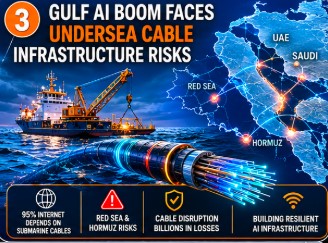
Gulf AI Expansion Faces Major Undersea Cable Infrastructure Challenge
The Gulf region’s rapidly expanding artificial intelligence industry is facing a major infrastructure challenge linked to undersea internet cables and digital connectivity resilience.
Countries including the UAE and Saudi Arabia are investing billions into AI infrastructure projects, hyperscale data centers, and cloud computing systems. However, experts warn that much of the region’s digital traffic still depends heavily on a limited number of undersea cables passing through geopolitically sensitive areas such as the Red Sea and the Strait of Hormuz.
Industry analysts estimate that nearly 95% of international internet traffic relies on submarine cable systems. Any disruption caused by conflict, sabotage, or technical failure could severely impact AI services, cloud platforms, financial systems, and enterprise operations across the Gulf.
The issue has gained urgency after previous cable disruptions in the Red Sea reportedly caused billions of dollars in economic losses and internet slowdowns. As Gulf countries aim to become global AI hubs, stable digital infrastructure is becoming as important as energy infrastructure.
Regional telecom operators and governments are now exploring alternative terrestrial routes through countries such as Iraq, Jordan, Syria, and Turkey to reduce dependence on vulnerable maritime chokepoints.
Experts believe infrastructure resilience will become one of the most important competitive factors in the global AI economy. Hyperscale cloud providers and AI companies increasingly require highly reliable network systems before investing billions into new regional facilities.
The situation demonstrates how AI leadership depends not only on chips and data centers but also on secure global connectivity systems capable of supporting massive digital workloads.
Source : Wired Gulf.